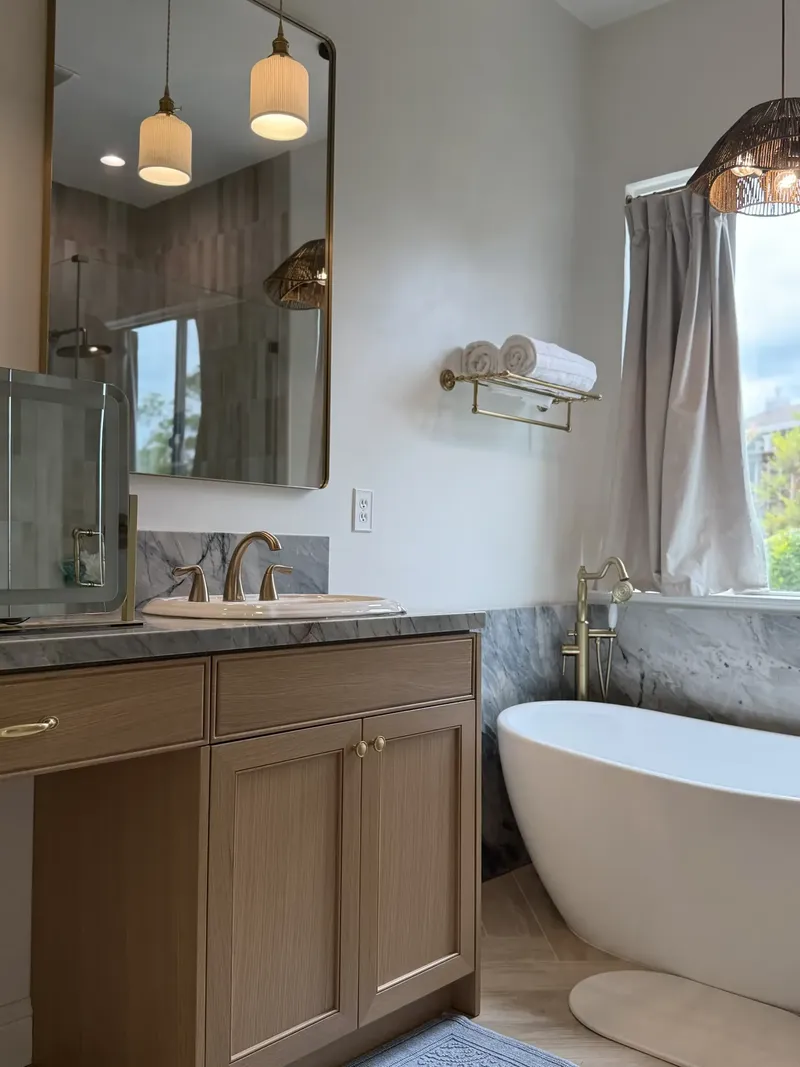
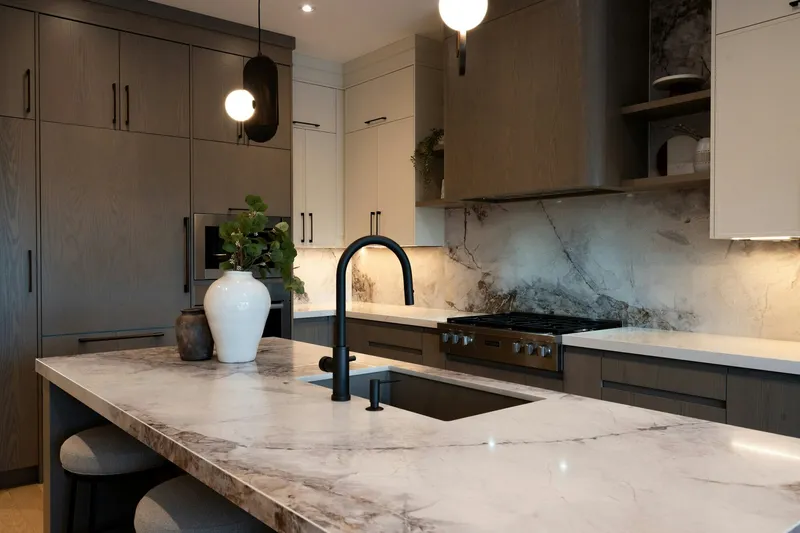
Cabinets eat more of a kitchen budget than anything else in the room, and the stock-versus-custom decision is where most of that money gets decided. Homeowners usually walk in with a vague sense that "custom is nicer" and "stock is cheaper," which is true as far as it goes, but it skips the part that actually matters: what you're getting for the difference, and whether your kitchen even needs it.
We build both. Here's the honest version of how to decide, not the version that steers you toward whichever one has a better margin.
What "Stock" Actually Means
Stock cabinets come pre-built in fixed sizes, usually 3-inch increments, in a limited set of finishes and door styles. You're picking from a catalog, not designing from scratch. The boxes are typically particle board or MDF with a laminate or thin veneer finish, and the whole point is that they're mass-produced, which is exactly what makes them affordable.
The catch is the fixed sizing. A kitchen that isn't a perfect multiple of standard cabinet widths ends up with filler panels — blank strips of matching material that close the gaps. One or two fillers, no big deal. A kitchen full of them starts looking like it was assembled rather than designed, and you're paying for cabinet space you can't actually use.
What "Custom" Actually Means
Custom cabinetry is built to the exact dimensions of your space, no fillers, no wasted inches, any configuration you want. Corner cabinets that actually use the corner. A cabinet that's 14.5 inches wide because that's what fits, not 15 or 18 because that's what came in the catalog. Wood species, finish, hardware, interior layout — all of it is a decision you make instead of a decision that's already been made for you.
Construction quality is the other half of it. Custom shops build with plywood boxes and real joinery, not staples and particle board. That's not marketing language — it's the actual difference between a cabinet box that holds up to 20 years of daily use near moisture and one that starts sagging at the joints after five.
Where Semi-Custom Fits
There's a real middle option that gets skipped in most of these comparisons. Semi-custom cabinets use a modified version of the stock system: more size increments, more finish choices, sometimes a few layout modifications, but still built on a production line rather than one at a time. Plywood box construction is common at this tier, which already puts it ahead of true stock in durability.
For a lot of Sacramento-area kitchens, semi-custom is the actual sweet spot. You get most of the fit and quality of custom without the full custom price tag or the full custom lead time.
The Real Cost Difference
These are general planning ranges for our area — your actual number depends on kitchen size, wood species, and how much of the layout is standard versus custom.
| Tier | Typical Cost | What You're Getting |
|---|---|---|
| Stock | $100 to $300 / linear ft | Fixed sizes, laminate finishes, particle board construction, fast turnaround |
| Semi-custom | $150 to $650 / linear ft | More sizes and finishes, plywood boxes, some layout flexibility |
| Full custom | $500 to $1,200+ / linear ft | Built to exact dimensions, any wood species, full design freedom |
The spread inside each tier is wide because wood species and finish do as much to the price as the construction method does. A semi-custom kitchen in maple with a simple painted finish can cost less than a stock kitchen with premium hardware and soft-close upgrades tacked onto every door.
Lead Time Is the Part People Forget to Ask About
Stock cabinets are often available in a week or two, sometimes off the shelf at a big box store. Semi-custom typically runs 4 to 6 weeks. Full custom is 8 to 12 weeks, sometimes longer for specialty finishes or during busy seasons.
This matters more than most homeowners expect going in, because the cabinets are usually the long pole in the whole remodel schedule. You can't install countertops until the cabinets are in, and you can't finish the kitchen until the countertops are in. If you're planning a remodel around a deadline, work backward from the cabinet lead time, not forward from when you'd like to start.
Order cabinets before demo starts, not after. We've seen kitchens sit half-finished for a month because cabinets were ordered on the same timeline as the rest of the project instead of ahead of it.
Where Stock Actually Makes Sense
Stock isn't a downgrade in every situation, and it's worth saying that plainly. A rental property, a short-term flip, a kitchen you know you'll gut again in five years when you finally do the full remodel — stock cabinets are the right financial call in all of those cases. The durability gap only matters if you're planning to live with the cabinets long enough for it to show up.
Where Custom Actually Makes Sense
If you're staying in the house for a decade or more, or if your kitchen has an awkward layout — a weird corner, a low ceiling section, an appliance that isn't a standard size — custom stops being a luxury and starts being the thing that makes the kitchen work at all. Filler panels and mismatched proportions are cosmetic annoyances in a kitchen you're leaving soon. In a kitchen you're keeping, you notice them every single day.
Storage-heavy households are the other clear case. Custom interior configurations (pull-out spice racks, appliance garages, drawer dividers built to your actual dishware) solve real daily friction that a stock cabinet's generic interior just can't.
What This Means for Resale
Semi-custom is usually the safest bet if resale is a factor. Full custom rarely returns its full cost at sale — buyers can see that the kitchen is nice, but they're not paying a premium for joinery quality they can't evaluate. Stock cabinets, on the other hand, can read as a red flag to buyers who've dealt with sagging particle board before, especially in a higher price bracket where they expect better.
If you're renovating specifically to sell within the next year or two, semi-custom in a neutral finish is almost always the right call — enough quality to photograph and show well, without paying for a decade of daily use you won't be around for.
Making the Call
The honest framework is simpler than most of what gets written about this decision: figure out how long you're keeping the kitchen, how unusual your layout is, and how much daily friction your current storage causes. Those three answers point you to stock, semi-custom, or full custom faster than any pros-and-cons list.
Our custom cabinetry page goes deeper into the materials and finish options we work with, and we're glad to walk through what makes sense for your specific kitchen — we do this consultation for homeowners across Rocklin, Granite Bay, Fair Oaks, and the rest of the greater Sacramento area, and it costs nothing to talk through.
If cabinets are part of a bigger kitchen remodel rather than a standalone project, our guide on what a full kitchen remodel actually costs breaks down how cabinet tier fits into the overall budget.