Sacramento Valley summers and Sierra foothill winters ask more of a deck than most manufacturers' spec sheets account for. A board that performs fine in a showroom in Portland can chalk, cup, or fade within two summers of direct Sacramento sun. The composite-versus-wood decision matters more here than in milder climates, and most of what gets written about it is generic advice that doesn't account for what actually happens to decking in our heat.
We build both. Here's what we've actually seen hold up.
What Composite Decking Actually Is
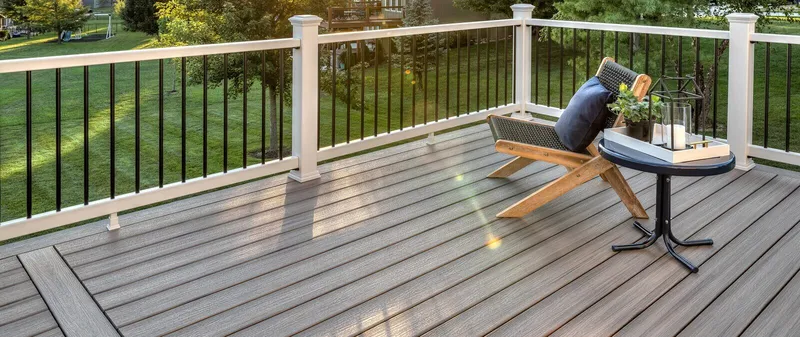
Composite decking (Trex, TimberTech, Fiberon, Azek) is manufactured from a blend of wood fiber and recycled plastic, usually with a plastic "cap" layer bonded over the core for weather and stain resistance. Capped composite is the standard now — uncapped composite from the early 2000s had real problems with moisture absorption and mold, which is where composite's bad reputation comes from. Modern capped boards don't have that issue.
The core benefit is stability: composite doesn't expand, contract, splinter, or need refinishing the way wood does. The tradeoff is heat. Dark-colored composite boards in direct Sacramento sun regularly hit surface temperatures 30 to 40 degrees hotter than the air temperature — walking barefoot on a dark brown composite deck at 2pm in July is a real problem, not a theoretical one. Lighter composite colors (grey, sand tones) run noticeably cooler and are what we recommend for anything getting full afternoon sun.
What Hardwood Decking Actually Is
"Hardwood" here covers two very different categories: domestic softwoods like redwood and cedar, and tropical hardwoods like ipe, cumaru, and tigerwood. They perform differently enough that lumping them together is misleading.
Redwood and cedar are naturally rot- and insect-resistant, look excellent when new, and are noticeably cooler underfoot than composite in direct sun. The tradeoff is maintenance: both need staining or sealing roughly every 1 to 2 years in our climate to prevent UV graying and surface checking, and skipping that maintenance for even one season shows.
Ipe and other tropical hardwoods are in a different category entirely — dense enough that they're naturally fire- and insect-resistant, can last 40-plus years, and hold up to UV exposure far better than redwood without sealing. The tradeoff is cost and installation difficulty: ipe is hard enough that it requires pre-drilling for every screw and specialized fasteners, which adds meaningfully to labor cost.
How Sacramento Heat Actually Affects the Decision
This is the part most decking comparisons written for a national audience skip entirely. Composite boards absorb and hold heat differently than wood, and in a climate that regularly hits 95 to 105 degrees for weeks at a stretch, that difference is the single biggest factor we see homeowners regret not considering.
Wood decking runs cooler in direct sun than dark composite in most side-by-side readings we've taken on job sites. If the deck gets full afternoon sun and bare feet are involved (pool decks, decks with kids), we steer people toward light-colored composite or a wood species over dark composite, regardless of what else they're weighing.
How Foothill Winters Affect the Decision
Sacramento proper rarely freezes hard, but a meaningful share of our clients are in El Dorado Hills, Folsom, and up into the foothills, where winter brings real freeze-thaw cycles and more rain-driven moisture than the valley floor gets.
Composite handles this well — it doesn't absorb water into the board structure, so freeze-thaw cycling doesn't cause the cracking or splitting that can happen with wood. Redwood and cedar can develop surface checking (small splits) after a few freeze-thaw seasons if the sealant coat has worn thin, which is the other reason the 1-to-2-year resealing schedule matters more in foothill locations than it does down in the valley.
Maintenance: The Real Ongoing Cost
This is where the total cost of ownership math actually gets decided, and it's the part homeowners underweight when comparing sticker prices.
Composite requires essentially no annual maintenance beyond periodic washing. It can scratch and it can stain from things like grease or wine if left to sit, but it doesn't need refinishing, ever.
Redwood and cedar need cleaning and a fresh coat of sealant or stain every 1 to 2 years to keep their look and UV resistance. Skip a cycle or two and you're looking at sanding and refinishing rather than a simple recoat, which is a bigger job. Ipe needs oiling roughly once a year to maintain its color (it will silver to a driftwood grey without it, which some homeowners actually prefer and choose not to fight).
If low maintenance is the actual priority, composite wins outright — there's no wood species where "some maintenance" becomes "none." If the goal is the specific look and feel of real wood underfoot and you're willing to stay on a resealing schedule, redwood or ipe are both legitimate choices; just budget the maintenance time honestly before you decide, not after the first summer.
The Real Cost Difference
These are general installed-cost ranges for our area — your actual number depends on deck size, substructure condition, height/railing requirements, and how much of the layout is straightforward versus custom.
| Material | Typical Installed Cost | What You're Getting |
|---|---|---|
| Pressure-treated wood | $15 to $25 / sq ft | Lowest upfront cost, needs the most ongoing maintenance, shortest lifespan of the group |
| Redwood or cedar | $25 to $40 / sq ft | Natural rot resistance, real wood look and cool underfoot, annual-ish resealing required |
| Mid-grade composite | $30 to $45 / sq ft | Low maintenance, wide color range, runs hotter in direct sun in darker tones |
| Premium composite | $45 to $60 / sq ft | Better fade/stain resistance and longer warranties (25 to 50 years depending on brand) |
| Tropical hardwood (ipe) | $45 to $65+ / sq ft | 40+ year lifespan, minimal maintenance for a real-wood product, highest install labor cost |
The spread inside each tier depends heavily on substructure work. If your existing framing and footings are sound, you're paying mostly for boards and fastening. If the substructure needs rebuilding, that cost applies equally regardless of which decking material you choose on top of it.
Lifespan and Warranties
Pressure-treated wood typically needs full replacement or major rebuild in 10 to 15 years. Redwood and cedar, maintained on schedule, run 15 to 25 years. Premium composite carries manufacturer warranties of 25 to 50 years against fading, staining, and structural issues (check the specific brand — Trex Transcend and TimberTech AZEK carry longer warranties than entry-level composite lines). Ipe, properly installed, regularly exceeds 40 years and can go longer.
Where Hardwood Still Makes Sense
If you want the specific look, texture, and cooler underfoot feel of real wood, no composite fully replicates it, and some homeowners aren't interested in a substitute. Ipe in particular makes sense for homeowners who want a premium, high-end look and are comfortable with the higher install cost in exchange for a genuinely long lifespan and minimal required maintenance. Redwood makes sense on a budget where the homeowner is realistic about the resealing commitment and values the classic Northern California look.
Where Composite Makes Sense
If you want to actually spend your weekends using the deck instead of maintaining it, composite is the straightforward answer, especially in a lighter color that won't overheat in direct Sacramento sun. It's also the more forgiving choice for rental properties and second homes where nobody's going to keep up with a resealing schedule reliably.
Making the Call
The decision comes down to three honest questions: how much annual maintenance are you actually going to do (not planning to do — actually going to do), how much direct afternoon sun does the deck get, and is a specific real-wood look and feel a priority you're not willing to trade away. Answer those three honestly and the material choice mostly picks itself.
Our custom deck building page covers our approach to substructure, materials, and permitting in more detail, and we walk through material selection with every homeowner before anything gets ordered — we build decks for clients across El Dorado Hills, Roseville, and the rest of the greater Sacramento area, including plenty of foothill properties where the freeze-thaw questions above come up regularly.
If a deck is part of a bigger backyard or home project, our guide on what a kitchen remodel actually costs is a useful reference for budgeting a larger renovation alongside it.